
Old School Music
They Were Recording a Song About Him — Then He Suddenly Appeared
In 1975, Pink Floyd were recording an album about absence, isolation, fame, and everything they felt they had lost.
Then something happened that none of them expected.
Their former bandmate Syd Barrett suddenly walked into Abbey Road Studios.
The man who had helped create Pink Floyd had been gone from the band for years. Now he was standing inside the studio while they were recording music that had, in many ways, been shaped by his absence.
And the timing couldn’t have been more haunting.
The album they were making was Wish You Were Here.
The Man Who Started Pink Floyd
Before Pink Floyd became one of the biggest bands in the world, Syd Barrett was at the center of it.
He was the band’s original lead singer, guitarist and principal creative force during their earliest years.
Barrett helped establish the strange, psychedelic sound that made Pink Floyd stand out in London’s underground music scene.
But fame came quickly.
And it became increasingly difficult for Barrett to function within the band.
By 1968, Pink Floyd had effectively moved on without him.
David Gilmour had joined the group and eventually became one of its defining voices and guitarists.
Barrett left Pink Floyd behind.
But the band never completely left him behind.
His absence continued to affect them for years.
Then Pink Floyd Became Massive
By 1973, Pink Floyd had achieved something they could hardly have imagined during their early club days.
The Dark Side of the Moon had become a worldwide phenomenon.
Suddenly, they were one of the biggest bands on the planet.
But success didn’t necessarily make them happier.
The pressure of following such an enormous album weighed heavily on the group.
They were exhausted.
They were increasingly uncomfortable with the music business.
And they were beginning to think about what success had actually cost them.
Those feelings became the foundation of their next album.
The Album Was About Absence
Pink Floyd began recording Wish You Were Here at Abbey Road Studios in January 1975.
The sessions continued intermittently for several months.
The album explored several connected ideas.
The emptiness of fame.
The music industry’s treatment of artists.
Isolation.
Alienation.
And, perhaps most importantly, the absence of someone who had once been at the heart of the band.
That person was Syd Barrett.
Roger Waters wrote the lyrics to the title track and to “Shine On You Crazy Diamond,” the enormous nine-part composition that bookends the album.
“Shine On” was explicitly a tribute to Barrett.
And “Wish You Were Here” carried another nod toward him.
Then, while they were making it, something almost unbelievable happened.
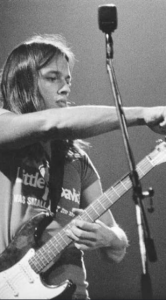
Syd Barrett Walked Into Abbey Road
On May 5, 1975, Barrett showed up at Abbey Road without announcing that he was coming.
Pink Floyd’s official timeline confirms the appearance.
The band was working on Shine On You Crazy Diamond.
And suddenly, there he was.
The man they were writing about.
The man whose absence had become one of the emotional foundations of the album.
Standing in the studio.
After years away.
It was so unexpected that at first the band members didn’t immediately recognize him.
Barrett had changed dramatically.
He had gained weight and shaved his head and eyebrows.
His appearance was so different that it took the others some time to realize who was actually standing in front of them.
Nobody Knew What to Say
The moment was incredibly emotional for the band.
They hadn’t seen Barrett in years.
And now they were face-to-face with him while recording a song inspired by his disappearance from their lives.
According to accounts of the session, Barrett listened to what they were doing.
He was reportedly carrying a plastic shopping bag containing his belongings.
At one point, someone asked him what he thought of the music.
His response was reportedly positive.
But the entire encounter was deeply strange.
The person they remembered from the early days of Pink Floyd seemed almost like a different man.
And then, after spending some time with them, Barrett left.
That was essentially the last time the members of Pink Floyd saw him.
The Song Suddenly Meant Something Different
Imagine recording a song called “Shine On You Crazy Diamond.”
A song about someone you lost.
A song about someone who helped create your band.
A song about absence.
And then that person walks through the studio door.
That’s what happened to Pink Floyd.
The coincidence was almost impossible to comprehend.
But there was another layer to it.
The title track itself was also about absence.
“Wish You Were Here” wasn’t simply a song about missing one person.
Roger Waters later described the album’s central idea more broadly: the feeling of being separated from yourself, from other people, and from what originally mattered.
That’s why the song has remained so powerful.
You don’t need to know the Pink Floyd story to understand it.
Almost everyone has missed someone.
Almost everyone has experienced a moment when they wished someone could simply be there.
David Gilmour’s Guitar Made It Personal
Musically, the song was built around an acoustic guitar.
David Gilmour played the famous opening figure, giving the recording an intimate quality that contrasted with the enormous sound of much of Pink Floyd’s other work.
The song eventually grows into a full band performance, but it never loses that feeling of someone sitting alone with a guitar.
That simplicity was part of its power.
After the huge production of The Dark Side of the Moon, Pink Floyd had created something that felt almost like a conversation.
Quiet.
Personal.
Human.

Then Came the Famous Album Cover
Even the album artwork reflected the same idea.
Two businessmen appear to shake hands outside a Los Angeles office building.
One of them is literally on fire.
The image was designed by the creative team Hipgnosis and became one of the most recognizable album covers in rock history.
The handshake represented the emptiness that can exist behind business relationships.
Even the original album was wrapped in black plastic, hiding the artwork and band name.
Everything about the package was built around the idea of absence.
The Album Became Huge
Wish You Were Here was released in September 1975.
It reached No. 1 in both the United Kingdom and the United States, becoming Pink Floyd’s first album to top the charts on both sides of the Atlantic.
The album eventually became one of the band’s defining records.
And the title song became one of Pink Floyd’s most beloved recordings.
It was different from their heavier progressive-rock material.
It wasn’t about spectacle.
It was about feeling.
And Syd Barrett Never Knew What It Became
There’s something especially sad about that studio visit.
Barrett was physically there.
He was standing in the same room as the people with whom he had built Pink Floyd.
But he wasn’t really part of the band anymore.
He had arrived just as they were creating one of their most personal tributes to him.
Then he disappeared from their lives again.
Syd Barrett died in 2006, decades after leaving Pink Floyd.
But his influence never disappeared.
Neither did his absence.
More Than 50 Years Later
Wish You Were Here was released in 1975.
Half a century later, its central emotion still feels remarkably simple.
Missing someone.
Wondering where they went.
Remembering who they used to be.
And wishing, even for a moment, that they were standing beside you again.
The strange thing is that Pink Floyd didn’t have to invent that feeling.
They lived it.
They had lost a friend, a bandmate and one of the people who helped create the group.
Then, while making an album about his absence, he suddenly walked through the door.
For one brief moment, the person they had spent years missing was right there in the room.
And somehow, that makes the song feel even more powerful.
Because sometimes you don’t realize how much someone is missed…
until they’re suddenly standing in front of you again.