
Old School Music
They Called Her a Freak… Until They Saw What She Could Do
She could hold a grown man over her head in each hand.
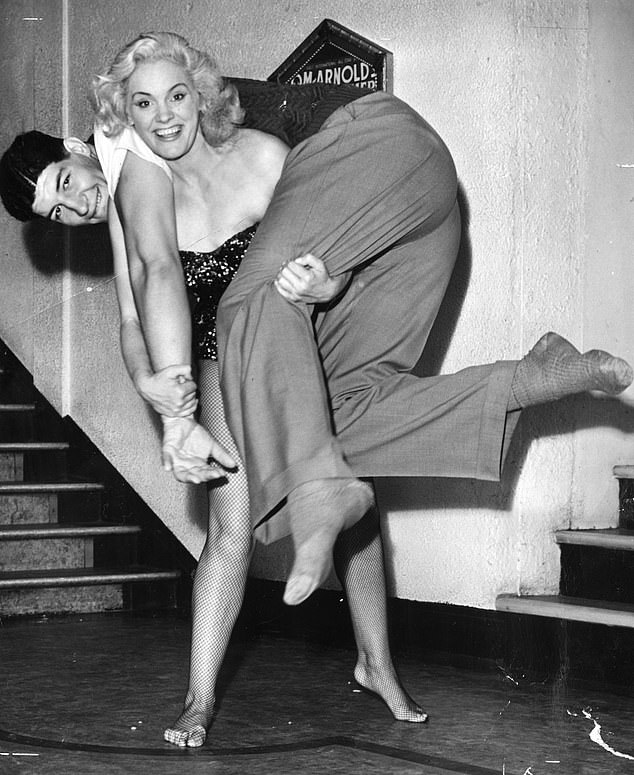
Not a trick. Not a stooge. A real man, hoisted skyward while the audience gasped and her red nail polish stayed flawless.
Her name was Joan Rhodes, and for twenty-five years she was billed as the strongest woman in the world.
She was born in London on April 13, 1921, into poverty so complete that it is difficult to imagine today. Her parents dated briefly, then walked out — first her mother, then her father — leaving Joan and her young siblings alone. She was around three years old. The children might not have survived if neighbors hadn’t noticed that no adult was coming home. There was a period in the workhouse, separation from her siblings, and eventually life with a strict aunt who ran a pub and told the little girl to her face that she was “big” and “ugly.” Joan carried those words with her for the rest of her life.
But it was in that pub that she discovered the thing that would eventually save her.
The beer barrels were heavy — the kind grown men struggled to move two at a time. Joan, barely twelve years old, lifted them as if they were shopping bags. The customers couldn’t believe it. Neither, at first, could she.
At fourteen, she ran away. She slept rough around Soho, busking to survive, sleeping in hotel doorways and on street corners. Somewhere during those hungry years, she realized that the strength that had amazed people in the pub could earn her a living. On the streets of 1930s London, she began bending six-inch nails, snapping steel, and tearing thick telephone directories cleanly in half with her bare hands.
The crowds stopped. The hats filled.
She answered an advertisement in The Stage newspaper looking for “freaks” and eventually made her variety debut at the Nottingham Empire. The billing said freak. The reality was almost the opposite: petite, blonde, with a 22-inch waist and the appearance of a chorus girl. The only unusual thing about Joan Rhodes was that she could bend an iron bar with her teeth.
She leaned into the glamour. Sequined gowns, fishnets, and teetering stilettos became part of the act. She called herself the Mighty Mannequin and the Iron Girl in a Velvet Glove. For her finale, she would pull a man from the audience, lift him overhead, and walk away without a hair out of place.
Here is what most people miss: in an industry built almost entirely on illusion, Joan’s entire act depended on there being no illusion at all. She actually preferred performing in cabaret rooms rather than large theaters, because she wanted the audience close enough to see that none of her equipment was rigged. She wanted them near enough to catch her cheating — precisely because there was never any trick to catch. When a top talent agent once asked her what the secret was, she answered by scooping him off his feet and carrying him around a billiards hall. She signed with him on the spot.
And she kept the evidence. Late in life, she donated physical proof of her career to the Victoria and Albert Museum — a steel bar bent by her hands and a London telephone directory torn cleanly in two, still labeled in her own handwriting: “Torn by Joan Rhodes, 1947.” She once estimated that over twenty-five years she had ripped through roughly 25,000 telephone books and bent more than two and a half tons of nails.
The fame that followed sounds almost invented. She appeared on American television, including Ed Sullivan’s The Toast of the Town. She toured the United States and Europe. The sculptor Henry Moore and the painter Lucian Freud used her as a model. She counted writer Quentin Crisp and film legend Marlene Dietrich among her friends, with Dietrich leaving expensive little gifts on her dressing table. Joan also loved telling the story of meeting Elvis Presley in a Paris dressing room, usually with a raised eyebrow and just enough mystery to make people wonder what really happened.
Then there was Bob Hope. Joan toured with Hope entertaining troops, and part of her routine involved lifting the comedian high overhead. During a USO show in Iceland just after Christmas in 1955, something went wrong. She lost her balance — a rare occurrence — and the two of them came crashing down in front of the soldiers, who roared with laughter, convinced it was part of the act. It wasn’t. She had genuinely dropped one of the most famous men in show business. Years later, when Hope was honored on This Is Your Life, Joan was invited to lift him once again. That time, she held on.
What makes her story so powerful isn’t the strength alone. It’s the arithmetic of her life. A child who had been abandoned and called ugly, spending time in a workhouse, grew up to bend iron in front of royalty and become a model for two of the century’s greatest artists. The insult was meant to make her feel small. Instead, she spent the next seventy years becoming impossible to ignore.
Even the ending refused to be ordinary. She appeared in films along the way, including Burke & Hare, The Pink Panther Strikes Again in 1976, and The Elephant Man in 1980. When she finally stepped away from the stage, she didn’t disappear into a quiet retirement. She opened a small café in North London’s Crouch End, near a theater school, where she became a favorite of drama students who had no idea that the friendly woman serving them tea had once made Bob Hope hit the floor. She published her memoirs in 2007 and died in 2010 at the age of 89, as beloved as she had ever been.
She spent her whole career being called a freak and answered by proving, night after night, that the only unbelievable thing about her was that it was all true.
The people who tell you what you’ll never be are rarely the ones who get to decide it.