
Old School Music
The Strange News Story That Inspired One of Rock’s Biggest Hits
When Van Halen released this song in 1983, fans probably weren’t expecting the band’s next huge hit to be built around a synthesizer.
After all, Van Halen had made its reputation with screaming guitars, massive riffs and Eddie Van Halen’s almost impossible guitar playing.
A keyboard-driven song didn’t exactly sound like the obvious next move.
But Eddie had something to prove.
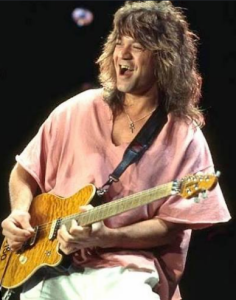
And the song that eventually became one of the biggest hits of the 1980s started with a piece of music his bandmates had originally wanted nothing to do with.
The story begins around 1981.
Eddie Van Halen had written the famous synthesizer riff that would eventually become the foundation of the song.
He loved it.
The rest of the band wasn’t convinced.
David Lee Roth and producer Ted Templeman were especially skeptical about taking Van Halen in a keyboard-heavy direction.
The problem was that Eddie wasn’t interested in simply repeating what the band had already done.
He wanted to experiment.
He wanted Van Halen to sound bigger.
And he wanted to prove that a synthesizer could belong in a rock song without taking away the band’s power.
For a while, the idea sat unused.
Then Eddie built his own recording studio, 5150.
That changed everything.
He finally had a place where he could experiment without needing everyone else’s permission.
And he brought the song back.
Once the music was ready, producer Ted Templeman asked David Lee Roth to listen to it.
Roth took the music with him while riding around Los Angeles in his 1951 Mercury convertible, with roadie Larry Hostler driving.
And that’s when the strange part of the story begins.
Roth later said he had recently seen a television news report about a man threatening to jump from a building.
The scene stuck in his head.
He imagined the people watching from below and thought about somebody in the crowd yelling something along the lines of “go ahead and jump.”
That became the seed for the lyrics.
Rhino has also reported this version of the story, while noting that Roth’s lyrics eventually moved away from the dark situation that inspired the idea and became much more positive.
And that’s an important distinction.
The finished song isn’t really about suicide.
It’s about taking a chance.
It’s about stepping forward.
It’s about telling somebody who is hesitating to stop being afraid and make a move.
The dark image that supposedly sparked the idea was transformed into something almost completely opposite.
The biggest surprise wasn’t even the story behind the lyrics.
It was the instrument.
The song was being driven by a synthesizer.
And Eddie Van Halen wasn’t just tolerating the keyboard.
He was playing it himself.
The main sound came from an Oberheim OB-Xa synthesizer, and the keyboard became the centerpiece of the entire recording.
For a guitarist who had already become famous for completely redefining electric guitar playing, it was another demonstration that Eddie wasn’t interested in being put into one box.
He could play guitar.
He could play keyboards.
And he could write a song around either one.
But not everybody in the band was immediately convinced.
This created another source of tension.
Roth was the frontman of one of the biggest hard-rock bands in America.
He didn’t necessarily want that band suddenly sounding like a pop-rock group.
But Eddie wasn’t backing down.
He had become frustrated with the direction of the band’s previous records, particularly the increasing number of cover songs on Diver Down.
He wanted more creative freedom.
“Jump” became part of that fight.
According to Eddie, when he first presented the keyboard idea, Roth and Templeman weren’t enthusiastic about it. Eddie eventually made it clear that he wanted to pursue the sound anyway.
And then something remarkable happened.
They recorded it.
Here’s another detail that makes the recording so interesting.
The song was already built around one of the most recognizable synthesizer riffs in rock history.
But Eddie still wanted to remind everyone that he was Eddie Van Halen.
So he added a guitar solo.
And it wasn’t some giant, extended guitar showcase.
It was relatively short.
Melodic.
Controlled.
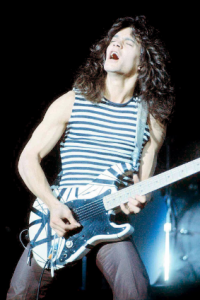
It served the song instead of overwhelming it.
That was a big change from the guitar pyrotechnics people had come to expect from him.
The result was a strange combination:
Synthesizer.
Arena rock.
Pop melody.
Heavy drums.
Guitar solo.
And David Lee Roth’s unmistakable voice.
It shouldn’t have worked.
But it did.
The song was released in December 1983 as the lead single from 1984.
And then MTV entered the picture.
The music video showed the band performing the song with the kind of wild energy that had become associated with Van Halen.
It didn’t need an elaborate storyline.
It simply showed the band being the band.
The combination of the huge synthesizer hook and Roth’s larger-than-life personality made the video perfect for MTV.
Suddenly, Van Halen wasn’t just a hard-rock band anymore.
They were becoming one of the biggest crossover acts in America.
The song climbed the charts.
And on February 25, 1984, it reached No. 1 on the Billboard Hot 100.
It was Van Halen’s first and only U.S. No. 1 single.
The album 1984 became enormous too, eventually reaching No. 2 on the Billboard 200.
Ironically, the album was kept from the No. 1 spot by another enormous record:
Michael Jackson’s Thriller.
Eddie had actually played the legendary guitar solo on Jackson’s “Beat It” the previous year.
So in a strange twist, Eddie Van Halen was involved in two of the biggest albums of the era while his own band was simultaneously becoming one of the biggest acts in America.
Behind the scenes, the success didn’t solve the disagreements between Eddie and David Lee Roth.
If anything, the band’s growing success made the differences more obvious.
Eddie wanted to experiment.
Roth wanted to maintain the band’s identity.
They were both strong personalities.
And eventually, the relationship broke down.
After the 1984 tour, Roth left Van Halen in 1985.
The original lineup was over.
But the song survived.
And it became bigger than the arguments that surrounded it.
There’s something almost perfect about the transformation.
The song’s famous keyboard riff was originally something Eddie’s bandmates didn’t want.
The lyrics were reportedly sparked by a disturbing news story.
And the final song sounded nothing like the obvious next step for a hard-rock band.
Yet it became Van Halen’s biggest American hit.
That’s why the song remains so fascinating.
It’s proof that sometimes the idea everyone thinks is wrong is exactly the idea that changes everything.
And there’s an important caveat to the famous origin story.
David Lee Roth has told different versions of what inspired the lyrics over the years. American Songwriter notes that while he has discussed the television news story, he has also given other explanations, including one involving a stripper.
So we can’t say with absolute certainty that one television report was the sole inspiration.
But Roth’s news-story explanation has been repeated for decades, and it remains one of the most widely reported origins of the song.
Today, the opening synthesizer riff is practically synonymous with 1980s rock.
And that’s pretty damn remarkable when you remember how unusual it seemed inside Van Halen.
Eddie Van Halen had spent years convincing the world that the electric guitar could do things nobody had imagined.
Then he picked up a synthesizer and did it again.
The band that had built its reputation on guitar-driven hard rock produced a keyboard-led anthem.
A lyric supposedly sparked by a disturbing television report became a message about taking a chance.
And the song everyone thought might take Van Halen in the wrong direction became the band’s only No. 1 single on the Billboard Hot 100.
Sometimes the biggest hits don’t come from following the formula.
They come from the moment somebody says:
“What if we do something completely different?”
And in Van Halen’s case, that decision changed everything.