
There are songs that become popular for a season, and then there are songs that quietly become part of our lives forever, with “Moon River” belonging unmistakably to the second kind.
When Audrey Hepburn sat on a fire escape in Breakfast at Tiffany’s and gently sang those opening words in 1961, cinema gave the world a moment that has never truly faded.
Nothing dramatic happened in that scene, yet millions of people still remember exactly how it made them feel more than six decades later.
Perhaps that is because “Moon River” never tries to impress us with power, but instead whispers directly to the places in our hearts where memories quietly live.
The melody, written by Henry Mancini with lyrics by Johnny Mercer, feels less like a performance and more like an old friend telling a story beneath a sky full of stars.
Every gentle note carries the feeling of someone searching for a place they have never seen but somehow always believed existed.
Audrey Hepburn was not known as a professional singer, and that may have been the greatest gift the song ever received.
Her fragile, almost conversational voice makes Holly Golightly seem beautifully human instead of impossibly glamorous.
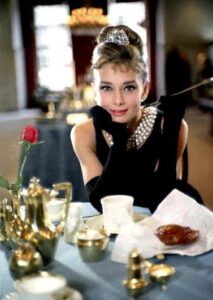
The elegance of Breakfast at Tiffany’s often dazzles viewers with pearls, black dresses, and New York sophistication, yet this quiet song reveals the loneliness hidden beneath all that sparkle.
For just a few minutes, Holly stops pretending to be someone the world expects and simply becomes a young woman dreaming about tomorrow.
That honesty is why the scene continues to touch audiences who were born decades after the film first appeared.
Many legendary songs grow larger over time through bigger arrangements and louder performances, but “Moon River” has remained unforgettable because it refuses to become louder than the emotions it carries.
Its simplicity allows every listener to place their own memories inside the melody.
Some hear childhood dreams that never disappeared.
Others remember first love, long train rides, distant hometowns, or evenings when life seemed wonderfully full of possibility.
The words “two drifters off to see the world” have become one of cinema’s most enduring expressions of hope.
They remind us that life is rarely about arriving at a perfect destination.
Instead, it is about continuing the journey even when the road ahead remains uncertain.
Johnny Mercer reportedly drew inspiration from the rivers and landscapes of his Southern childhood, giving the lyrics an authenticity that cannot be manufactured.
The river becomes more than water flowing toward the sea.
It becomes every dream we quietly carry while pretending to be perfectly content with ordinary life.
That universal longing explains why listeners from different generations continue discovering the song as though it were written just for them.
Parents introduce it to their children.
Grandparents smile when they hear it unexpectedly in a café or on the radio.
Young movie lovers stumble upon the fire escape scene online and suddenly understand why older generations never stopped talking about it.
Very few film moments bridge so many decades without losing their emotional power.
The black-and-white elegance of classic Hollywood may belong to another era, but the feelings inside “Moon River” remain timeless.
Loneliness has never gone out of style.
Hope has never become old-fashioned.
Dreams still ask us to believe in places we cannot yet see.
Perhaps that is why the song sounds as fresh during a quiet evening today as it did in 1961.
It asks for nothing except a willing heart and a few peaceful minutes.
Once the melody begins, the noisy world somehow feels farther away.
The city lights grow softer.
The rushing hours slow down.
Even our own worries seem willing to sit quietly beside that imaginary river for just a little while.
Generations of artists have recorded beautiful versions of “Moon River,” each bringing new colors to its familiar melody.
Yet many listeners continue returning to Audrey Hepburn’s original performance because its imperfections feel wonderfully real.
She never sounds like someone trying to create musical history.
She sounds like someone trying to understand her own heart.
That sincerity cannot be rehearsed.
It cannot be manufactured inside a recording studio.
It simply exists in a rare moment when character, actress, music, and emotion become inseparable.
The Academy Award for Best Original Song confirmed its artistic achievement, but awards alone cannot explain its remarkable endurance.
Countless Oscar winners have slowly disappeared from popular memory.
“Moon River” never did.
Instead, it quietly became one of those songs people carry through every chapter of life.
It accompanies romances that blossom unexpectedly.
It comforts hearts after painful goodbyes.
It returns during nostalgic evenings when old photographs remind us how quickly time has passed.
Like the river itself, the song keeps flowing gently from one generation to the next without ever losing its direction.
Its greatest achievement may not be its beautiful melody or poetic lyrics.
Its greatest achievement is reminding us that every dreamer, every wanderer, and every hopeful soul is traveling the same river together.
And perhaps that is why, whenever Audrey Hepburn begins singing beneath the New York sky, we are no longer simply watching a classic movie scene.
For a few unforgettable minutes, we become fellow travelers on that endless moonlit river, believing once again that somewhere beyond the next bend, our brightest dreams are still waiting.