
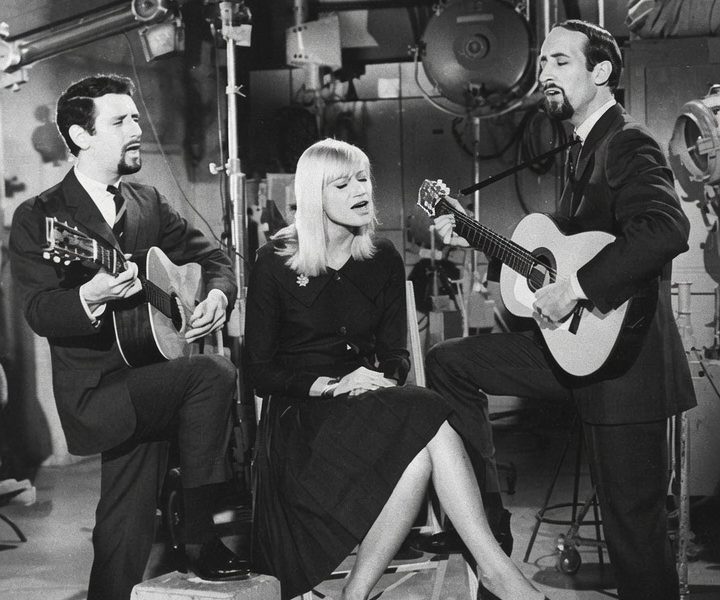
There are songs that feel less like performances and more like memories drifting through the fog of a quiet morning, and “Early Morning Rain” has always belonged to that rare category.
Long before airports became crowded monuments to speed and convenience, this song captured something much deeper than travel itself: the loneliness of watching life move forward while you remain standing still.

When Peter, Paul & Mary recorded the song, they transformed it into something gentle and timeless, wrapping its sadness inside harmonies so warm that listeners could almost forget how heartbreaking the story truly was.
The opening moments feel like stepping onto a deserted airfield before sunrise, when the sky is still gray and the world seems suspended between yesterday and tomorrow.
You can almost hear distant engines humming somewhere beyond the horizon while cold morning air settles over empty pavement.
At first glance, the lyrics appear simple, telling the story of a traveler stranded and longing to leave.
But beneath that surface lies a feeling that nearly everyone recognizes, even if they have never stood near an airport runway in their lives.
It is the feeling of being left behind while something important disappears into the distance.
Peter, Paul & Mary understood how to communicate that emotion without exaggeration or dramatic gestures.
Their voices never demand attention.
Instead, they invite listeners into a quiet conversation filled with reflection and longing.
That restraint is precisely what gives the song its extraordinary power decades later.
Many songs about heartbreak rely on tears, anger, or desperation.
“Early Morning Rain” chooses a different path.
Its sadness arrives softly, like mist gathering over a field before dawn.
The narrator watches airplanes preparing for departure and feels an ache that extends far beyond travel itself.
The aircraft become symbols of freedom, opportunity, and escape.
Meanwhile, he remains grounded, trapped by circumstances he cannot control.
That contrast between movement and stillness forms the emotional center of the song.
Almost everyone reaches a moment in life when they watch another person, another dream, or another chapter move away from them.
Sometimes there is nothing to do except stand quietly and watch it go.

That universal truth helps explain why the song continues to resonate across generations.
Listeners hear their own stories hidden inside its gentle melody.
Some remember lost relationships.
Others think about opportunities they never pursued.
Many simply remember younger versions of themselves standing at emotional crossroads they can never revisit.
Peter, Paul & Mary bring remarkable sensitivity to every line.
Their harmonies flow together so naturally that it becomes difficult to separate one voice from another.
The result feels less like three singers performing and more like a shared human experience being carried through music.
There is also something uniquely nostalgic about the recording itself.
The acoustic arrangement leaves plenty of space for silence to breathe between phrases.
Nothing feels rushed.
Nothing feels forced.
The song unfolds at the pace of memory, allowing each image and emotion to settle gently in the listener’s mind.
That slower rhythm feels especially meaningful today.
Modern life constantly pushes people toward the next destination, the next notification, the next distraction.
“Early Morning Rain” asks listeners to stop for a moment and simply feel.
Its emotional honesty remains remarkably refreshing in a world overflowing with noise.
Part of the song’s lasting appeal comes from its vivid imagery.
You can practically see the gray skies, the distant aircraft, and the solitary figure standing alone with his thoughts.
The setting may be specific, but the emotions are universal.
Even listeners who have never visited an airport understand exactly what the narrator is experiencing.
That ability to transform personal feelings into shared experiences is one of folk music’s greatest strengths.
Peter, Paul & Mary were masters of that tradition.
Throughout their career, they consistently found songs that spoke to ordinary human struggles and aspirations.
“Early Morning Rain” stands among their most poignant achievements.
The song also reflects a period when travel carried a sense of mystery and wonder that has largely faded from modern culture.
Airplanes were not merely transportation.
They represented possibility.
They symbolized worlds waiting beyond the horizon.
Watching one depart could feel like watching an entire future disappear into the clouds.
That emotional weight gives the song an almost cinematic quality.
Every verse feels like a scene from a film that exists somewhere between reality and memory.
Listeners become passengers on a journey defined not by distance but by emotion.
Perhaps that is why the song ages so gracefully.
Its themes are not tied to a particular decade, fashion trend, or cultural moment.
Longing remains longing.
Hope remains hope.
Loss remains loss.

Human emotions change far less than technology does.
For many listeners today, hearing “Early Morning Rain” feels like opening an old photo album discovered in a forgotten drawer.
The images may belong to another era, yet the feelings remain surprisingly familiar.
Each note carries traces of people, places, and moments that time has slowly carried away.
And still the song survives.
Year after year, generation after generation, it continues finding new listeners willing to pause and listen.
Some discover it through folk music collections.
Others encounter it by chance late at night when nostalgia feels especially close.
Almost everyone who hears it carefully finds something personal hidden within its melody.
By the final notes, there is no dramatic resolution or triumphant conclusion.
The traveler’s longing remains unresolved.
The airplanes continue their journeys.
The morning continues unfolding.
Yet somehow that lack of closure feels perfectly appropriate.
Life rarely provides neat endings.