
Old School Music
He Was Ready to Give Up — Then His Father Said Three Words
In the 1970s, Jonathan Cain was struggling.
He had moved to Los Angeles chasing a career in music, but things were not going the way he had hoped. His record deal with Warner Bros. had fallen apart, and he was working a day job while trying to keep his musical dreams alive.
Then another problem hit.
His dog was struck by a car, leaving Cain with a veterinary bill of about $1,000. He didn’t have the money.
So he called his father.
Cain was frustrated and discouraged. He was seriously considering giving up on music and returning home to Chicago.
His father listened.
Then he told his son to stay.
He told him that his biggest breakthrough was still ahead of him.
And then he gave him three words that Cain would carry with him for years:
Don’t stop believing.
Cain wrote those words down.
At the time, they were simply something his father had said during a difficult phone call.
He had no idea they would eventually become the foundation of one of the most recognizable songs in American music.
The Words Stayed With Him
Cain continued working.
He eventually joined the band The Babys, and later his career took another major turn when he was invited to join Journey.
By the time Cain became part of Journey, he had already kept those words in his notebook for years.
He hadn’t forgotten them.
Then Journey began working on what would become their 1981 album Escape.
The band already had several songs.
But they needed one more.
Steve Perry suggested that Cain look through his notebooks for ideas.
Cain went home and started searching.
Then he saw it.
The phrase his father had given him years earlier was sitting on the page.
Don’t Stop Believin’.
Cain immediately knew he had something.
He sat down at his Wurlitzer electric piano and began building a chorus around the phrase. He later said he had the basic chorus together in roughly 20 minutes.
But the song was nowhere near finished.
Cain brought the idea to Journey.
Steve Perry and guitarist Neal Schon began shaping it with him.
And something unusual happened.
The song didn’t follow the normal structure people expected from a rock hit.
Instead of giving listeners the chorus immediately, the band kept building tension.
The famous title doesn’t appear until surprisingly late in the song.
That was partly intentional.
Perry understood that the song needed what he called a “chorus of choruses”—a final section that would lift everything that came before it.

Then They Needed a Story
The words weren’t simply about Cain’s father anymore.
Cain and Perry began imagining the people they saw around Los Angeles.
People arriving in the city with dreams.
People who had left home searching for something better.
People working long hours.
People taking chances.
People who weren’t sure whether their dreams would ever come true.
Cain later described the song as being inspired by the dreamers and strangers moving along Sunset Boulevard.
That gave the song its characters.
A small-town girl.
A city boy.
A midnight train.
Strangers searching in the night.
The details made the song feel like a story about specific people.
But underneath it was the same message Cain’s father had given him years earlier.
Keep going.
Don’t give up on the dream.
The Song Wasn’t an Immediate No. 1
Journey released the song in 1981 as the second single from Escape.
It became a major hit.
But it did not immediately become the gigantic anthem we know today.
It reached No. 9 on the Billboard Hot 100.
For a major Journey song, that was successful.
But something happened afterward that nobody could have fully predicted.
The song refused to disappear.
It kept finding new audiences.
Years passed.
Then decades.
And suddenly, a song that had been released in 1981 was becoming even bigger in the digital era.
Its appearances in television, movies, sports arenas, commercials, karaoke bars, and countless other places introduced it to generations who weren’t even alive when it was recorded.
Its use in the final episode of The Sopranos in 2007 became one of its most famous modern moments.
The song had escaped its original era.
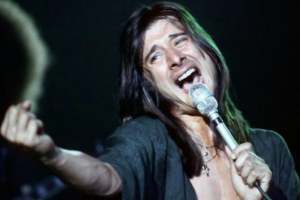
And Then the Internet Changed Everything
The digital age gave the song another enormous boost.
It became one of the most downloaded songs originally released in the 20th century.
Journey’s official site says the recording eventually reached 18-times Platinum certification and passed seven million digital downloads.
That is an extraordinary second life for a song that was already decades old.
But the numbers aren’t really the reason people still remember it.
It’s the feeling.
Because almost everyone understands the situation at the center of the story.
You have a dream.
You don’t know whether it will work.
You get tired.
You question yourself.
You wonder whether it’s time to quit.
And sometimes, one person tells you to keep going.
For Jonathan Cain, that person was his father.
His father wasn’t a famous songwriter.
He wasn’t sitting in a recording studio.
He wasn’t trying to create a hit.
He was simply talking to his son.
And those words eventually traveled from a difficult family phone call to a notebook, from that notebook to a Journey rehearsal room, and finally into the lives of millions of listeners.
There is even a famous little detail hidden inside the lyrics.
The song says “born and raised in South Detroit.”
Steve Perry later acknowledged that there isn’t really a place commonly known as South Detroit. He chose the phrase because the words sounded right and carried the feeling he wanted.
It didn’t matter.
People sang it anyway.
And they still do.
More than four decades after its release, the song has become bigger than the band, bigger than the album, and even bigger than the story that inspired it.
It started with a struggling musician who was thinking about going home.
His father told him not to give up.
Cain wrote those words down.
Years later, he turned them into music.
And somehow, the entire world started singing the same message back.
Don’t stop believing.