
Old School Music
The Guitar Riff That Started as a Joke
Some of the greatest songs in rock history begin with a carefully planned idea.
This one began with a guitarist messing around.
Slash wasn’t sitting down trying to write a future classic. He was playing around with a guitar pattern during rehearsal, almost like a musical exercise. But when the rest of Guns N’ Roses heard it, something started to happen.
Axl Rose heard the riff.
Then he began working on lyrics.
And suddenly, the band had the beginnings of a song that would change their career forever.
By the time Guns N’ Roses were putting together their debut album, Appetite for Destruction, they were still a young band trying to find their identity.
They had the attitude.
They had the musicians.
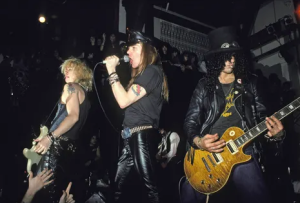
They had the songs.
But they were still largely unknown outside the Los Angeles rock scene.
Slash had developed the famous opening guitar figure while fooling around with different ideas.
It wasn’t originally intended to become a major composition.
The riff was almost playful compared with some of the darker, heavier material the band was working on.
But there was something about it.
It was instantly memorable.
And once the other musicians heard it, they began building around it.
Axl Rose was already writing lyrics and melodies, and the guitar pattern gave him something completely different to work with.
The song would eventually become deeply personal.
Rose’s lyrics were inspired by his relationship with Erin Everly, whom he was dating at the time.
Instead of writing another aggressive hard-rock song about rebellion, drugs or life on the road, Guns N’ Roses suddenly had something vulnerable.
Something romantic.
Something almost unexpectedly sweet.
And that contrast became one of the song’s greatest strengths.
The band that had introduced itself to the world with songs like “Welcome to the Jungle” suddenly had a love song that could reach far beyond the hard-rock audience.
That was part of what made it so powerful.
Appetite for Destruction was packed with raw, aggressive songs.
“Welcome to the Jungle” sounded dangerous.
“It’s So Easy” was cynical.
“Mr. Brownstone” dealt with addiction.
“Paradise City” was huge and anthemic.
Then there was this song.
It began with a delicate guitar figure that sounded almost nothing like the band’s reputation.
And then Axl’s voice entered.
The arrangement gradually grew larger, eventually exploding into the kind of hard-rock climax the band was known for.
It was a strange combination:
soft beginning, emotional lyrics, enormous guitars.
And somehow, it worked.
Guns N’ Roses recorded the song for Appetite for Destruction, their debut album.
The album was released in 1987 and eventually became one of the landmark records of late-1980s rock. The Rock & Roll Hall of Fame lists “Sweet Child O’ Mine” among the defining recordings from the album.
But there was a problem.
The song was nearly six minutes long.
For a rock band trying to get radio airplay, that wasn’t exactly ideal.
The band and label eventually released an edited version as a single.
And that’s when everything changed.
The opening guitar notes became almost impossible to forget.
Within seconds, listeners knew what they were hearing.
But the song wasn’t simply successful because of the guitar.
The emotional contrast made it stand out.
Slash’s guitar provided the signature.
Axl’s vocal gave it personality.
The lyrics gave it vulnerability.
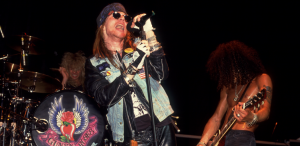
And the entire band turned what began as a simple guitar idea into something enormous.
The song eventually reached No. 1 on the Billboard Hot 100, giving Guns N’ Roses their first—and, at the time, only—No. 1 single on that chart. The Rock & Roll Hall of Fame specifically describes it as a No. 1 hit.
The band had gone from Los Angeles club stages to the top of the American charts.
And the song that helped get them there began with a guitarist simply playing around.
There’s another reason the song endured.
Even though its lyrics came from Axl Rose’s relationship with Erin Everly, listeners didn’t need to know anything about their relationship to connect with it.
People heard their own stories.
They thought about wives.
Girlfriends.
First loves.
People they had met when they were young.
People who had changed their lives.
That’s what happens with a great love song.
Eventually, the original story becomes only part of it.
The song starts belonging to everyone who hears it.
For Slash, the opening guitar part became one of the defining moments of his career.
For Guns N’ Roses, the song proved they could do something their image didn’t necessarily suggest.
They could be vulnerable.
They could be romantic.
They could write something beautiful without losing the attitude that made them Guns N’ Roses.
And that combination helped turn Appetite for Destruction into a landmark album.
The Rock & Roll Hall of Fame later inducted Guns N’ Roses, recognizing the band’s impact on rock music and highlighting “Sweet Child o’ Mine” among their major songs.
There’s something almost funny about the way the song began.
Nobody needed a grand plan.
Nobody knew they were creating a song that would eventually become one of the most recognizable guitar introductions in rock.
It started with Slash experimenting.
Axl heard something in it.
The band built a song around it.
And a deeply personal love story gave the music its emotional center.
Then millions of people heard it.
What started as a guitarist fooling around with a riff became the first Guns N’ Roses song to reach No. 1 in America.
The band had been trying to make a name for themselves.
Instead, they accidentally created a song that generations would know within the first few seconds.
And that’s perhaps the best part of the story.
Sometimes the songs that change everything aren’t the ones you plan for.
Sometimes they’re the ones that happen when you’re just messing around.