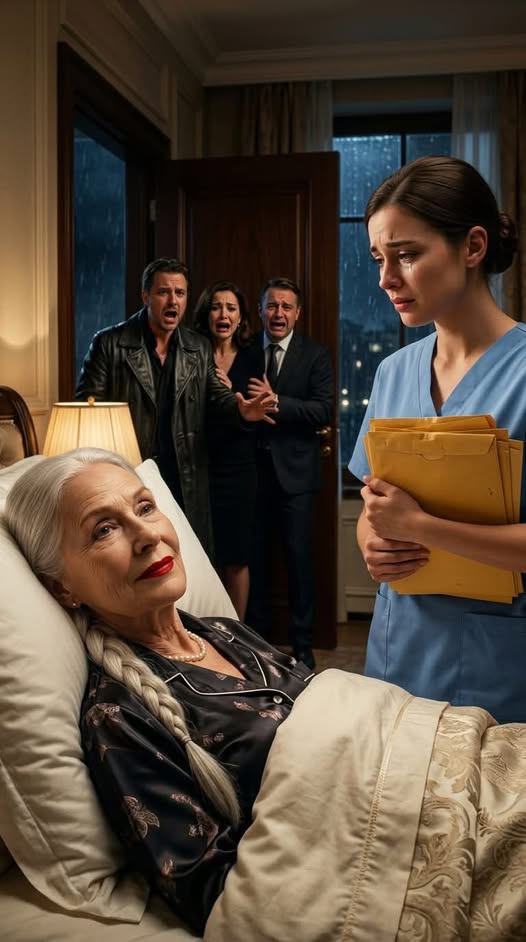
Every morning, 80-year-old Evelyn put on red lipstick, waiting for children who never came.
One day, she overheard her daughter on speakerphone: “Don’t spend another dime on her. Just tell her we visited while she slept, her memory is shot anyway.” Evelyn didn’t cry. On her deathbed, she put on her finest dress and called her attorney. As her three children rushed in to claim their inheritance, she flatlined. Then, the lawyer handed each of them a thick yellow envelope. The first sentence inside destroyed them…
“Don’t turn off the light, Clara,” Mrs. Evelyn whispered. “My children are coming for me tonight.”
She said it at 11:46 p.m. from room 8 at St. Raphael’s Senior Care Home, just outside San Antonio, Texas. Her white hair was braided neatly, her lips were painted a defiant crimson red, and a string of fake pearls rested over her navy-blue dress like she was waiting for a grand jubilee.
But she wasn’t going to a party.
She was dying.
“Mrs. Evelyn,” I said gently, my hand resting near the light switch, “you need to rest. Let the storm pass.”
“I’ll rest when they get here,” she answered, her eyes fixed on the heavy wooden door.
The words hit me hard because she said them almost every single day.
Every morning, she asked for her silver hand mirror, her face powder, and “just a little lipstick so I don’t look forgotten.” Then she would sit by the window, hands folded in her lap, waiting for footsteps that never echoed down our hallway.
She had three children.
Robert, the oldest, owned a highly advertised auto parts empire up in Austin.
Claudia, the middle child, posted Bible verses online every morning and publicly branded herself a woman of unwavering faith.
And Daniel, the youngest, the golden child, the one who once promised her at his father’s funeral that he would never leave her alone.
Daniel was the one who brought her to the facility.
“Just two weeks, Mom,” he told her. “Only while contractors remodel your master bedroom.”
He arrived with a brown leather suitcase, a hand-knitted afghan, and a tin of Danish butter cookies. Mrs. Evelyn looked radiant that day, almost humming with excitement, because she believed her children were building her a sanctuary.
“They’re putting my bed near a window,” she told me with a smile. “Daniel said I’ll be able to see the garden.”
Two weeks bled into seven months.
Seven months metastasized into two years.
The afghan lost the comforting scent of home, the cookie tin sat empty on her dresser catching dust, and her children simply faded away.
At first, they sent voice messages.
“Soon, Mom.”
“Next weekend, Mom.”
“Just be patient, Ma.”
Then came the recycled excuses.
Traffic on I-35.
An audit at work.
A bad cold.
Always something seemingly urgent.
Every Sunday, Mrs. Evelyn put on her nicest cardigan and saved foil-wrapped caramel candies in her purse for grandchildren who never walked through our doors. She sat in the visitors’ lounge from ten in the morning until the sun went down.
“They probably got a flat tire,” she would murmur.
And every Sunday, I smiled through my teeth, swallowing my anger.
Because no one was coming.
Then one Thursday afternoon, she heard the truth.
Claudia called the nurses’ station and didn’t realize the speakerphone was on.
“My mother is very old,” Claudia snapped. “If her heart condition flares up, don’t transfer her to a private hospital. We’re not spending another dime on something useless.”
I froze.
Mrs. Evelyn was standing right behind me, leaning heavily on her wooden cane.
Claudia continued.
“And if she asks for us, just tell her we visited while she was sleeping. Her memory is shot anyway. She won’t know the difference.”
Mrs. Evelyn didn’t cry.
That was a thousand times worse.
A terrifying, icy calm washed over her face. She just turned around slowly and walked back to her room.
The next morning, she asked me for a stack of legal paper.
“What for, Mrs. Evelyn?” I asked softly.
She looked at me with tired eyes but a deadly steady voice.
“To remind my children that being old does not mean being stupid.”
For three days, she wrote.
Page after page.
Sometimes her hand shook so violently I had to sit beside her and hold the clipboard still. When she finished, she folded the documents with surgical precision and placed them inside her leather Bible.
I didn’t ask what she had written.
But I knew those pages were about to change everything.
On her last night, she asked for her finest navy-blue dress, her polished black shoes, and the fake pearls.
“Tonight they’ll come,” she whispered.
At 11:30 p.m., her blood pressure dropped.
At 11:46 p.m., she asked me not to turn off the light.
At 11:50 p.m., heavy footsteps echoed down the corridor.
Her face changed.
She smiled—a genuine, haunting smile.
But it wasn’t her children.
It was Mr. Sterling Ocampo, a high-profile attorney from downtown San Antonio, soaked from the thunderstorm, holding three thick yellow envelopes under his arm.
“Mrs. Whitaker asked me to come before the light went out,” he said.
She lifted one trembling hand.
“Come in, counselor,” she whispered. “My children may be late again, but let the reckoning begin.”
Then, outside the facility, headlights swept across the wet asphalt.
Three luxury SUVs violently braked in the parking lot.
Robert barged in first, his face flushed with arrogance.
Claudia followed, already contorting her face into a mask of preemptive sorrow.
Daniel slipped in last, clutching a thick black folder tightly against his chest like a life preserver, hiding a secret he thought no one knew.
Mrs. Evelyn turned her head toward the door.
Her breath was fading, but her voice sliced through the air.
“Don’t cry for me like orphaned children,” she said, “when you haven’t looked at me as your mother in years.”
And right after she spoke those words, the heart monitor flatlined. She closed her eyes for the last time.
The room immediately erupted into a theater of fake sobs.
That was when Mr. Ocampo stepped out of the shadows, silencing their performance, and placed the three yellow envelopes on the foot of her bed.
One for Robert.
One for Claudia.
One for Daniel.
They came expecting to divide an easy inheritance. But inside each envelope was a final, devastating lesson from a woman they thought was too old to fight back…